Making Tax Digital: What It Means for You and How to Get Ready
What Is Making Tax Digital and Does It Affect Me?
One of the questions I regularly get asked by business owners and landlords is:
"Do I really need to start reporting my income to HMRC every three months?"
For many people, the answer is now yes.
Making Tax Digital (MTD) is changing how sole traders, landlords and VAT-registered businesses keep their financial records and report information to HMRC.
If you're used to keeping receipts in a folder, using spreadsheets or handing everything to your accountant once a year, you may need to change the way you manage your finances.
But don't worry. Making Tax Digital doesn't necessarily mean your tax has increased or that you'll have to pay tax four times a year.
It mainly changes how you keep your records and how often you report information to HMRC.
Let's look at what this means in practice.
What Exactly Is Making Tax Digital?
Making Tax Digital is an HMRC initiative designed to make the UK tax system more digital.
Instead of relying entirely on annual tax returns and manually prepared records, HMRC wants businesses and individuals to use compatible software to record their income and expenses.
The aim is to make tax reporting more accurate, reduce errors and help people understand their financial position throughout the year.
There are two main areas you need to know about:
Making Tax Digital for VAT – already applies to almost all VAT-registered businesses.
Making Tax Digital for Income Tax – being introduced in stages for sole traders and landlords.
The requirements are different depending on your circumstances.
Who Needs to Follow Making Tax Digital for Income Tax?
This is particularly important if you're self-employed or receive rental income.
MTD for Income Tax started on 6 April 2026, with more people joining over the following years.
The timetable is based on your qualifying income.
| Start date | Qualifying annual income |
|---|---|
| 6 April 2026 | Over £50,000 |
| 6 April 2027 | Over £30,000 |
| 6 April 2028 | Over £20,000 (planned) |
Important: These thresholds are based on your gross qualifying income, not your profit.
Example: You're a Sole Trader
Let's say you're a self-employed electrician.
Your annual turnover is £55,000.
Your business expenses are £20,000.
Your taxable business profit is £35,000.
You might think MTD doesn't apply because your profit is below £50,000.
However, the threshold is based on your £55,000 turnover, not your £35,000 profit.
If that qualifying income was reported on your 2024/25 tax return, you would normally have been required to join MTD from April 2026.
What If I Have Both Self-Employment and Rental Income?
This is where many people get confused.
HMRC looks at your combined qualifying income from self-employment and property.
For example:
Self-employment turnover: £25,000
Gross rental income: £28,000
Total qualifying income: £53,000
Although neither source individually exceeds £50,000, the combined amount does.
This means you would normally fall within MTD from April 2026 if these were your relevant 2024/25 figures.
Employment income, dividends and most other types of income are not included when calculating the MTD qualifying income threshold.
However, they may still need to be declared as part of your annual tax reporting.
What Will I Actually Need to Do Under MTD?
If MTD for Income Tax applies to you, there are three main requirements.
1. Keep Digital Records
You will need to maintain digital records of your business or property income and expenses using compatible software.
This doesn't necessarily mean you must buy expensive accounting software.
Depending on your circumstances, you may be able to continue using spreadsheets alongside suitable bridging software.
2. Submit Quarterly Updates
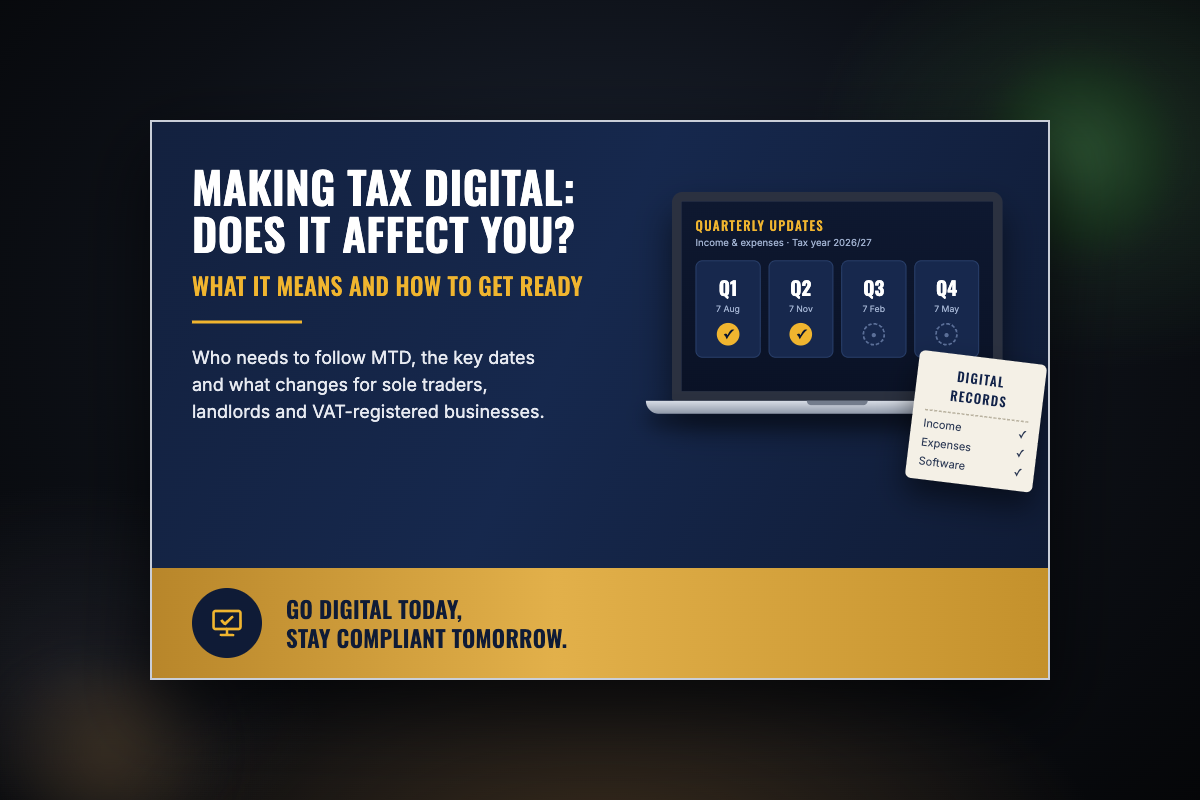
Instead of reporting your business income only once a year, you'll need to send updates to HMRC every quarter.
The standard quarterly reporting deadlines are:
| Reporting period | Submission deadline |
|---|---|
| 6 April – 5 July | 7 August |
| 6 July – 5 October | 7 November |
| 6 October – 5 January | 7 February |
| 6 January – 5 April | 7 May |
Alternative calendar-quarter reporting periods may be available.
These updates provide HMRC with information about your income and expenses.
You do not normally need to pay Income Tax every quarter simply because you submit quarterly updates.
Your usual Self Assessment payment deadlines generally remain in place.
3. Complete Your Annual Tax Return
Quarterly updates do not remove the need to finalise your annual tax position.
After the tax year ends, you will still need to report any additional income, claim relevant reliefs and make the necessary tax adjustments.
The annual deadline remains 31 January following the end of the tax year.
For example, the final annual submission for the 2026/27 tax year will normally be due by 31 January 2028.
What If I'm a Landlord?
If you receive rental income from property, Making Tax Digital may apply to you even if you don't consider yourself a business owner.
For example, imagine you own two rental properties.
Property 1 generates £18,000 per year.
Property 2 generates £20,000 per year.
Your total gross rental income is £38,000.
You may need to join MTD from April 2027, depending on your qualifying income for the relevant tax year.
If you also have self-employment income, HMRC generally considers both income sources together when checking the threshold.
Landlords with jointly owned properties need to report their own share of qualifying property income.
And if you have both UK and overseas rental properties, additional reporting requirements may apply.
What About Making Tax Digital for VAT?
Making Tax Digital for VAT is already mandatory for almost all VAT-registered businesses.
Since April 2022, VAT-registered businesses have generally been required to keep digital VAT records and submit VAT returns using compatible software.
This applies even if your turnover is below the VAT registration threshold but you are voluntarily VAT registered.
For example, if you run a limited company and use Xero to manage your bookkeeping and VAT returns, you may already be meeting the main MTD for VAT requirements.
However, simply having accounting software doesn't automatically mean everything is compliant.
Your records must be maintained correctly, and where multiple systems are used, the required digital links must be in place.
Can I Still Use Excel Spreadsheets?
Yes, in many cases.
This is a common concern, particularly among smaller businesses and landlords who have used spreadsheets for years.
HMRC doesn't necessarily require everyone to move to a full bookkeeping package.
You may be able to continue using Excel or another spreadsheet system, provided it is connected to compatible software that can submit the required information to HMRC.
This is commonly known as bridging software.
For example, you could:
Record rental income and expenses in Excel.
Use compatible bridging software to connect your records to HMRC.
Submit your quarterly updates electronically.
The important thing is to ensure your system meets the relevant MTD requirements.
Will Making Tax Digital Mean Paying More Tax?
No. Making Tax Digital does not, by itself, increase Income Tax rates.
However, it may change how you manage your finances.
For example, if you currently prepare your bookkeeping only once a year, moving to quarterly reporting means you will need to keep your records more up to date.
This could actually be beneficial.
Instead of finding out your tax liability months after the year has ended, you may have a clearer picture of your business income, expenses and expected tax bill throughout the year.
That can make budgeting and cash-flow planning much easier.
What Happens If I Don't Comply?
HMRC has introduced a points-based penalty system for late submissions under MTD for Income Tax.
Missing reporting deadlines can result in penalty points, and financial penalties may apply once the relevant threshold is reached.
There are also separate rules for late tax payments.
For VAT, businesses can face penalties for failing to use compatible software or maintain the required digital records.
The important thing is not to leave everything until the last minute.
Can I Be Exempt From Making Tax Digital?
Some individuals may qualify for an exemption.
For example, HMRC may consider an exemption where someone cannot reasonably use digital tools because of:
Age combined with circumstances affecting digital capability.
Disability or serious health conditions.
Religious beliefs.
Lack of reasonable access to the internet.
However, simply preferring paper records or not wanting to purchase software does not automatically qualify you for an exemption.
If you believe an exemption may apply, you should discuss your circumstances with HMRC or your accountant.
How Can I Prepare for Making Tax Digital?
If you're a sole trader or landlord, I recommend taking action before your mandatory start date.
First, check your qualifying income.
Look at your self-employment turnover and gross property income to establish when MTD applies to you.
Second, review your bookkeeping system.
Are you currently using spreadsheets, paper records or accounting software?
Consider whether your existing system will meet the new requirements.
Third, get your records organised.
Make sure your income and expenses are recorded regularly rather than leaving everything until the end of the tax year.
Finally, speak to your accountant.
An accountant can help you understand which rules apply, select suitable software and prepare for quarterly reporting.
A Simple Question to Ask Yourself
Before deciding whether MTD affects you, ask:
"How much gross income do I receive from self-employment and rental properties combined?"
If the amount exceeds the relevant threshold, you may need to follow the new reporting requirements.
Remember, the rules are based on qualifying income, not simply your profit or how much tax you pay.
And if you're unsure, it's always better to check before missing a reporting deadline.
Not Sure If Making Tax Digital Applies to You?
Making Tax Digital is one of the biggest changes to the UK tax reporting system in recent years.
Whether you're a sole trader, landlord or small business owner, understanding your obligations now can help you avoid unnecessary stress and potential penalties.
At AD Accounting & Business Solutions, we help businesses and individuals understand their tax obligations, choose suitable accounting software and keep their financial records organised.
Book a free 30-minute Business & Tax Review.
We'll discuss your circumstances, check when Making Tax Digital may apply to you and explain what you need to do next.
Book your free 30-minute review today and make sure you're prepared for the changes ahead.
